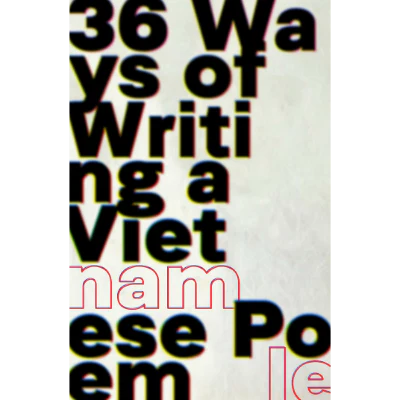
36 Ways Of Writing a Vietnamese Poem (Hardback) - Nam Le
Nam Le
Fifteen years after his best-selling, award-winning collection of stories The Boat, Nam Le returns to his great themes of identity and representation in a virtuosic debut book of poetry
36 Ways of Writing a Vietnamese Poem, says Le, a Vietnamese refugee to Australia, is ‘the book I need to write. The book I've been writing my whole life’. This book-length poem is an urgent, unsettling reckoning with identity and the violence of identity, embedded with racism, oppression and historical trauma. But it also addresses the violence in those assumptions – of being always assumed to be outside one’s home, country, culture or language. And the complex violence, for the diasporic writer who wants to address any of this, of language itself.
Making use of multiple tones, moods, masks and camouflages, Le’s poetic debut moves with unpredictable and destabilising energy between the personal and political, honouring every convention of diasporic literature – in a virtuosic array of forms and registers – before shattering the form itself. Like The Boat, 36 Ways of Writing a Vietnamese Poem conjures its own terms of engagement, escapes our traps, slips our certainties. As self-indicting as it is scathing, hilarious as it is desperately moving, this is a singular, breakthrough book.
Original: $19.37
-65%$19.37
$6.7836 Ways Of Writing a Vietnamese Poem (Hardback) - Nam Le
Nam Le
Fifteen years after his best-selling, award-winning collection of stories The Boat, Nam Le returns to his great themes of identity and representation in a virtuosic debut book of poetry
36 Ways of Writing a Vietnamese Poem, says Le, a Vietnamese refugee to Australia, is ‘the book I need to write. The book I've been writing my whole life’. This book-length poem is an urgent, unsettling reckoning with identity and the violence of identity, embedded with racism, oppression and historical trauma. But it also addresses the violence in those assumptions – of being always assumed to be outside one’s home, country, culture or language. And the complex violence, for the diasporic writer who wants to address any of this, of language itself.
Making use of multiple tones, moods, masks and camouflages, Le’s poetic debut moves with unpredictable and destabilising energy between the personal and political, honouring every convention of diasporic literature – in a virtuosic array of forms and registers – before shattering the form itself. Like The Boat, 36 Ways of Writing a Vietnamese Poem conjures its own terms of engagement, escapes our traps, slips our certainties. As self-indicting as it is scathing, hilarious as it is desperately moving, this is a singular, breakthrough book.
Product Information
Product Information
Shipping & Returns
Shipping & Returns
Description
Nam Le
Fifteen years after his best-selling, award-winning collection of stories The Boat, Nam Le returns to his great themes of identity and representation in a virtuosic debut book of poetry
36 Ways of Writing a Vietnamese Poem, says Le, a Vietnamese refugee to Australia, is ‘the book I need to write. The book I've been writing my whole life’. This book-length poem is an urgent, unsettling reckoning with identity and the violence of identity, embedded with racism, oppression and historical trauma. But it also addresses the violence in those assumptions – of being always assumed to be outside one’s home, country, culture or language. And the complex violence, for the diasporic writer who wants to address any of this, of language itself.
Making use of multiple tones, moods, masks and camouflages, Le’s poetic debut moves with unpredictable and destabilising energy between the personal and political, honouring every convention of diasporic literature – in a virtuosic array of forms and registers – before shattering the form itself. Like The Boat, 36 Ways of Writing a Vietnamese Poem conjures its own terms of engagement, escapes our traps, slips our certainties. As self-indicting as it is scathing, hilarious as it is desperately moving, this is a singular, breakthrough book.