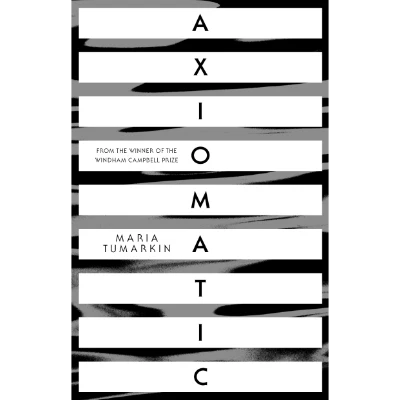
Axiomatic - Maria Tumarkin
Maria Tumarkin
Winner of the Melbourne Prize for Literature’s Best Writing Award
Shortlisted for the 2019 Stella Prize
The past shapes the present—they teach us that in schools and universities. (Shapes? Infiltrates, more like; imbues, infuses.) This past cannot be visited like an ageing aunt. It doesn’t live in little zoo enclosures. Half the time, this past is nothing less than the beating heart of the present. So, how to speak of the searing, unpindownable power that the past—ours, our family’s, our culture’s—wields in the present?
Stories are not enough, even though they are essential. And books about history, books of psychology—the best of them take us closer, but still not close enough. Maria Tumarkin's Axiomatic is a boundary-shifting fusion of thinking, storytelling, reportage and meditation. It takes as its starting point five axioms: ‘Time Heals All Wounds’; ‘History Repeats Itself’; ‘Those Who Forget the Past are Condemned to Repeat It’; ‘Give Me a Child Before the Age of Seven and I Will Show You the Woman’; and ‘You Can’t Enter The Same River Twice.’
These beliefs—or intuitions—about the role the past plays in our present are often evoked as if they are timeless and self-evident truths. It is precisely because they are neither, yet still we are persuaded by them, that they tell us a great deal about the forces that shape our culture and the way we live.
Axiomatic - Maria Tumarkin
Maria Tumarkin
Winner of the Melbourne Prize for Literature’s Best Writing Award
Shortlisted for the 2019 Stella Prize
The past shapes the present—they teach us that in schools and universities. (Shapes? Infiltrates, more like; imbues, infuses.) This past cannot be visited like an ageing aunt. It doesn’t live in little zoo enclosures. Half the time, this past is nothing less than the beating heart of the present. So, how to speak of the searing, unpindownable power that the past—ours, our family’s, our culture’s—wields in the present?
Stories are not enough, even though they are essential. And books about history, books of psychology—the best of them take us closer, but still not close enough. Maria Tumarkin's Axiomatic is a boundary-shifting fusion of thinking, storytelling, reportage and meditation. It takes as its starting point five axioms: ‘Time Heals All Wounds’; ‘History Repeats Itself’; ‘Those Who Forget the Past are Condemned to Repeat It’; ‘Give Me a Child Before the Age of Seven and I Will Show You the Woman’; and ‘You Can’t Enter The Same River Twice.’
These beliefs—or intuitions—about the role the past plays in our present are often evoked as if they are timeless and self-evident truths. It is precisely because they are neither, yet still we are persuaded by them, that they tell us a great deal about the forces that shape our culture and the way we live.
Product Information
Product Information
Shipping & Returns
Shipping & Returns
Description
Maria Tumarkin
Winner of the Melbourne Prize for Literature’s Best Writing Award
Shortlisted for the 2019 Stella Prize
The past shapes the present—they teach us that in schools and universities. (Shapes? Infiltrates, more like; imbues, infuses.) This past cannot be visited like an ageing aunt. It doesn’t live in little zoo enclosures. Half the time, this past is nothing less than the beating heart of the present. So, how to speak of the searing, unpindownable power that the past—ours, our family’s, our culture’s—wields in the present?
Stories are not enough, even though they are essential. And books about history, books of psychology—the best of them take us closer, but still not close enough. Maria Tumarkin's Axiomatic is a boundary-shifting fusion of thinking, storytelling, reportage and meditation. It takes as its starting point five axioms: ‘Time Heals All Wounds’; ‘History Repeats Itself’; ‘Those Who Forget the Past are Condemned to Repeat It’; ‘Give Me a Child Before the Age of Seven and I Will Show You the Woman’; and ‘You Can’t Enter The Same River Twice.’
These beliefs—or intuitions—about the role the past plays in our present are often evoked as if they are timeless and self-evident truths. It is precisely because they are neither, yet still we are persuaded by them, that they tell us a great deal about the forces that shape our culture and the way we live.